
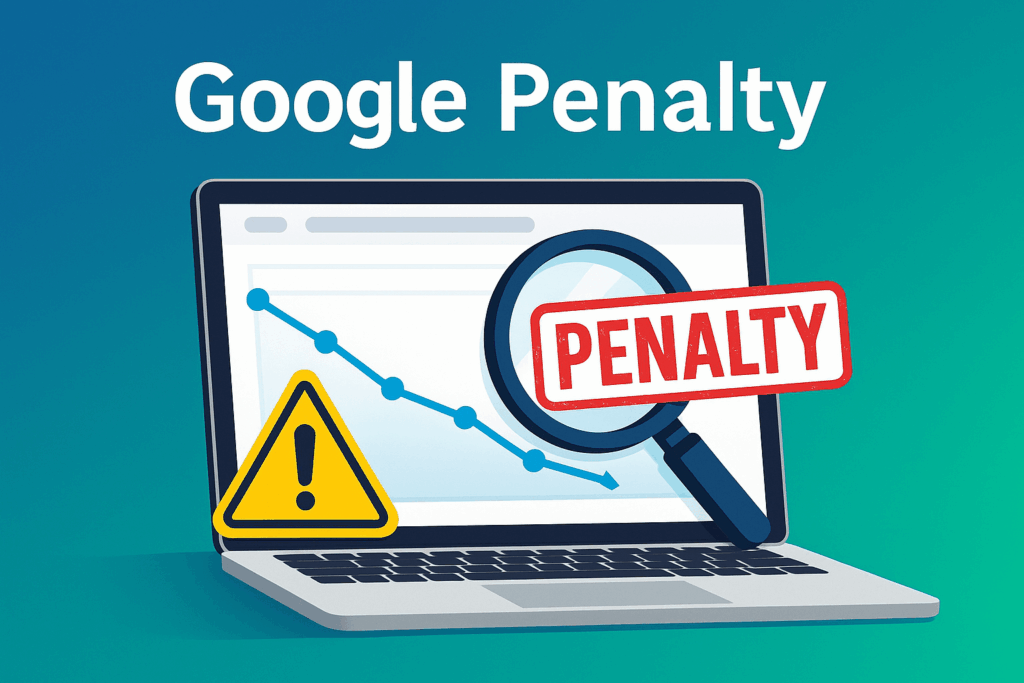
A Google penalty is like a warning. Google gives it to websites that break its rules. If your site does something Google doesn’t like, your rankings can drop. That means fewer visitors. Less trust. Less business. There are two types of penalties. One is called manual. The other is algorithmic. Let’s talk about manual penalties first. These are given by a real person from Google. Yes, an actual person checks your site and sees something wrong. Maybe your site has spammy links. Maybe you copied content from somewhere else. Or maybe your site is trying to trick the system. When Google sees this, they may send you a notice in your Search Console. Now the algorithmic penalty is different. This is done by Google’s system, not a human.

If your site uses bad SEO tactics, Google’s algorithm might catch it. It won’t tell you directly. You just see a sudden drop in traffic, and you won’t know why right away. But don’t panic. You can fix it. First, try to find the reason. Use Google Search Console. Look at your backlinks. Check your content. Is everything clean, honest, and helpful! If not, clean it up. Remove spammy links, rewrite poor content, make your site useful for real people not just for search engines.
Then, if it was a manual penalty, you can ask Google for a review. This is called a reconsideration request. If they approve, your rankings might come back. A Google penalty feels scary. It feels like all your work has been lost. But it’s not the end. Many people fix it. Many bounce back stronger. In this article, we are talking about this topic. So, keep reading to know more about it.
Google Penalty Meaning
So, a Google penalty can feel like a big punch in the gut. One day your website is doing well, getting clicks, traffic, and visitors. Then suddenly, it’s like your site has vanished. Your pages are no longer showing up in search results. People can’t find you. It feels unfair. It feels scary. But let’s break it down in a simple way. A Google penalty is when Google decides something is wrong with your website. It thinks you broke the rules. Maybe on purpose. Maybe by mistake. Either way, your site gets pushed down or completely out of search results. Google does this in two ways. One is manual, done by a real person. The other is automatic, done by Google’s system or algorithm. Both can hurt your site badly.
If you get hit, your site may drop to page 10 or not show up at all. This is bad. Because fewer people will visit your website. And that means less traffic, fewer customers, and maybe lost money too. If you run a business, this can be a real problem. You might feel lost or stressed. Many people do. But here’s the thing. It can happen to anyone. Even if you try to follow all the rules. Sometimes, using bad SEO tricks without knowing can trigger a penalty. Things like spammy backlinks, copying content, or keyword stuffing can get you in trouble. Fixing it is not easy, but it’s possible.
Solution
First, you need to find out why it happened. You can use tools like Google Search Console. It may give you a message. Then you need to clean up the problem. Maybe remove bad links, rewrite pages, or follow better SEO steps. Once you fix everything, you can ask Google to check again. This is called a reconsideration request. Some experts help with this. SEO teams that understand Google’s rules deeply. They help websites recover and return to the search results. If you’re not sure what to do, it’s okay to ask for help.
Remember, Google wants to give people the best answers. If your website is helpful, clear, and honest, Google will like it too. Don’t try to trick the system. Just focus on giving value to real people. A Google penalty is tough. But it’s not the end. With effort and care, you can bounce back stronger. Keep learning, keep improving, and stay honest. That’s the real key to long-term success.
Google Penalty Removal
So, you can fix it. Here are four simple steps you can take to get your website back on track.
Use Google’s Disavow Tool
So, this tool helps you get rid of bad backlinks. Bad links are one of the most common reasons for penalties. If your site has too many of these, Google might punish you. First, find the bad links. Then make a list of them in a .txt file. After that, go to Google’s Disavow Tool. Choose your website and upload the file. Hit submit. That’s it. This tells Google, “Hey, these links aren’t mine. Please ignore them.”
Fix Your Website
Your site must follow Google’s rules. These are written in their Webmaster Guidelines. Read them. Follow them. Don’t cut corners. It might feel boring or confusing, but doing it right helps a lot. Keep your site clean. Avoid shady tricks like keyword stuffing or hiding text. Also, stay updated with SEO news. Blogs like Search Engine Land and Search Engine Roundtable are great. They help you avoid mistakes that could hurt your site. Read Also : Google Word Coach
Make Better Content
Google wants useful content. Your readers do too. Write content that helps people. Make it clear, honest, and helpful. Avoid copying others. Don’t write for the algorithm, write for real people. Think about trust. Ask yourself, “Would I trust this page if I found it on Google?” If not, fix it.
Send a Reconsideration Request
After fixing your site, ask Google for another chance. Go to Google Search Console. Open the manual action report. Click on the link for reconsideration. Now tell them what you fixed. Be honest. Say sorry. Be clear. Keep it short. Attach proof if you have any. Then wait. Google will check your site again. If they see you tried your best, they might lift the penalty.
For Specific Penalties
Some penalties are very tough. Like when Google finds unnatural links or thinks your site is pure spam. If you bought links, posted fake comments, or did shady exchanges, clean those up fast. Remove what you can. Disavow what you can’t. If you get hit with a “pure spam” label, it’s serious. Google may have thought your site was made just to spam people. Check your content. Delete anything that looks fake or unhelpful. Make it better. Make it real. Sometimes penalties come from what a site used to be, not what it is now. So check the site’s old history on Archive.org just in case.
Google Penalty Checker tool
Google wants its search results to be clean, safe, and useful. So, if your website has things Google doesn’t like, such as spammy links, copied content, or too many ads, it might give your site a “penalty.” Now, this isn’t always your fault. Sometimes, a shady SEO service builds bad links for you. Or maybe you posted content years ago that’s now outdated. But once the penalty hits, your site will likely vanish from top search results. It hurts. It also feels like everything you worked on just got thrown away. You can’t fix a problem if you don’t know what it is.
This is why penalty checker tools are so helpful. These tools look at your site’s traffic and match it with Google’s updates. They help you see if your drop in visits is because of a Google penalty or just a normal dip. It’s like going to the doctor when you feel sick. You may be scared, but getting a clear answer brings peace. So, here are some trusted tools you can try.

FE International’s Google Penalty Checker
So, this one is simple. You just enter your website, and it shows if a penalty may have hit your traffic during a Google update.
Penguin Tool by Barracuda
Basically, it connects with your Google Analytics. Then it overlays your traffic drops with Google’s known updates. It’s really helpful and free to use.
MozCast
This tool shows how much change is happening in Google’s algorithm daily. If the “weather” looks stormy, maybe that’s why your site dropped.
SEMrush Site Audit
It doesn’t exactly say “penalty,” but it shows red flags on your site. These are like broken links, slow pages, or spammy backlinks that could lead to penalties.
Ahrefs and Google Search Console
Both can help you check your backlinks. If you see a lot of shady or unrelated websites linking to yours, that could be a problem.
Google Penalty Reasons
The truth is, there are many reasons why Google might punish a website. Let’s talk about them in simple, easy-to-understand words.
Bad or Unnatural Links Pointing to Your Site
Sometimes, other websites link to your pages. If those links are fake, spammy, or only made to cheat the ranking system, Google can see that. Even if you didn’t build those links yourself, it still affects your site. Google may think you’re trying to game the system.
Bad Links Coming From Your Site
Do you have links on your pages that go to shady websites? Maybe paid links or random ones that don’t make sense? If yes, Google could see that as a red flag. It wants links to be natural and useful, not tricky or paid.
Poor Quality Content
If your page has very little info, or if the content is too plain and says nothing new, that’s a problem. Google wants helpful, clear, and original content. Thin content makes your site look lazy and Google doesn’t like lazy people.
Tricky Images
Sometimes, a website shows one image to people, but a different one to Google. That’s sneaky. Google may think you’re trying to trick the system. And when you trick Google, a penalty often follows.
Spam From Outside Users
Do you let people leave comments or post on forums! That’s great for engagement, but if people start leaving spammy stuff, like shady links or nonsense text, it can hurt you. Google sees your whole site as the problem, not just the users.
Your Web Host is Known for Spam
If your website is hosted on a platform that’s filled with spammy websites, your site might get dragged down with it. It’s like living in a bad neighborhood, even if your house is clean, people may still judge it.
Bad Structured Data
Schema is code that helps Google understand your page better. But if you use it the wrong way like faking reviews or adding fake stars, Google can hit you with a penalty.
Cloaking or Sneaky Redirects
This is when you show one thing to users and something else to Google. Like sending Google to one page, and users to another. That’s considered cheating, and Google doesn’t play games like that.

Redirecting Mobile Users to Different Places
Some sites show desktop users a clean page, but mobile users get redirected somewhere weird. That’s unfair and confusing.
Breaking News or Discover Rules
If your site wants to show up on Google News or Discover, you have to follow the rules. If you break them by sharing misleading or low-quality news, Google can block your content from showing there.
Too Many Keywords
Stuffing your page with too many keywords just to rank higher. Google also sees right through that. It looks fake and unnatural. You don’t need to repeat the same word 100 times. Write for people not just for search engines.
Hacked Content
Hacked material means content or code added to a website without the owner knowing. This usually happens when the website gets hacked due to weak security. Once inside, hackers may add hidden links, fake pages, or redirect users to unsafe sites. Most of the time, the site owner has no idea this is happening. Hackers also use these websites for scams, phishing, or spreading viruses. It’s bad for everyone, both the website owner and the people who visit it. Moreover, the site can lose trust, traffic, and even get blocked by search engines. Visitors might end up on dangerous websites or get tricked into giving personal info.
